



Shooting dice means taking your turn as the active roller at the craps table – the player whose throws determine whether everyone wins or loses.
This guide covers the rules you must follow, how the Pass Line works, how to physically throw the dice, table etiquette, and what dice control is (and isn't).
New to craps entirely? Start with our how to play craps guide first.
How to Shoot Dice in Craps: 5-Step Overview
- Place a Pass Line or Don't Pass bet – required before you can shoot.
- When the stickman pushes the dice towards you, pick two with one hand.
- Throw in a visible arc – both dice must be airborne clearly enough for the boxman to see them.
- Both dice must hit the back wall of the table.
- On the come-out roll, aim for a 7 or 11. Once a point is set, repeat that number before rolling a 7.
Craps Shooter's Rules
Casinos enforce four non-negotiable rules for the throw. Breaking any of them results in a "no roll" call from the boxman. If that happens, the throw doesn't count, and you re-throw.
One hand only
Pick up and throw the dice with one hand. Switching hands mid-throw, cupping the dice in both palms, or passing them between hands before releasing will void the roll.
Loft the dice in a visible arc
The dice must leave your hand and travel visibly through the air. A flat throw that skims the felt is a no-roll. The boxman needs to see both dice in the air to confirm a clean release.
Hit the back wall
Both dice must reach the far end of the table and strike the back wall. The wall is lined with irregular pyramid bumps that randomise the bounce, which is the point. The casino needs unpredictable results to maintain its edge.
Have a bet on the table first
No bet, no throw. The minimum wager is fine; you don't need to match what others have put down.
Understanding the Pass Line bet
The Pass Line is the bet every shooter must make. It pays even money (1:1) and carries a house edge of 1.41%.
Once a point is established, you can place a free odds bet behind it. That’s the only wager in the casino with zero house edge.
The come-out roll
Every round starts with a come-out roll. The outcome determines what happens next:
- 7 or 11 – Pass Line wins. A new come-out follows.
- 2, 3 or 12 – Pass Line loses (called "craps"). The shooter keeps the dice; losing on the come-out does not end your turn.
- 4, 5, 6, 8, 9 or 10 – That number becomes the point. The dealer flips the puck to "On" and places it in the box for that number.
Making the point and sevening out
Once a point is set, the shooter must roll that number again before rolling a 7. Every other number is irrelevant to the Pass Line.
Roll the point first, and Pass Line wins; roll a 7 first (sevening out), and Pass Line loses. If that happens, the dice pass to the next shooter. Sevening out is the only outcome that ends your turn.
How to Hold and Throw the Dice
There's no single correct grip. These three are the most common:
Two-finger grip (most common). Place the dice side by side, flat faces aligned. Pinch them between thumb and middle finger along the seam, with both fingers touching both dice simultaneously. Swing your arm in a pendulum motion and release upward into an arc.
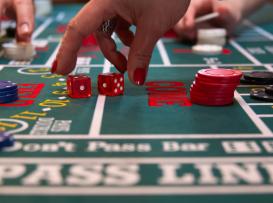
Three-finger grip. Cradle the dice between your thumb, index finger, and middle finger, resting against your fingertips. The throw comes more from the wrist. Comfortable for players with smaller hands.
Palm wrap. Wrap your full hand around the dice and use a backhand throw. The least precise option, but some first-time shooters find it the most natural starting point.
Whatever grip you choose, the mechanics of throwing dice in craps are the same: smooth release, visible arc, and back wall.
Shooter Etiquette
- Choose the dice quickly. The stickman pushes several towards you, so pick two and get on with it. Spending time inspecting them holds up the game.
- Keep your hands clear when the shooter is throwing. "Hands high" is the standard at most tables. Don't reach across the layout mid-roll.
- If you set the dice, do it fast. Orienting the dice before a throw is allowed, just don't make it a ritual that slows everyone down.
- Stay calm when you seven out. It happens to everyone. Pick up your remaining chips and step back without drama.
- Don't celebrate visibly at others' expense. If you're on Don't Pass and the table loses, keep it quiet.
Key Craps Terms for Shooters
Come-out roll – The first roll of a new Pass Line sequence. Results in a natural (7/11), craps (2/3/12), or a point.
Point – The number (4, 5, 6, 8, 9 or 10) the shooter must repeat before rolling a 7 to win the Pass Line.
Seven out – Rolling a 7 after a point is set. Loses the Pass Line and ends the shooter's turn.

Free odds – A bet placed behind your Pass Line wager after a point is set. Paid at true odds with no house edge.
Stickman – The crew member who controls the dice, calls results, and returns them to the shooter after each roll.
Boxman – The table supervisor who rules on no-roll calls and resolves disputes.
No roll – A throw declared void. Causes: dice didn't reach the back wall, weren't visibly airborne, or two hands were used. The shooter re-throws.
Dice Control: What It Is And What It Isn't
Dice control is the practice of setting the dice in a specific orientation and throwing them as softly as possible to reduce random bouncing, with the aim of lowering the frequency of 7s once a point is established.
It’s legal. Casinos allow dice setting, though they'll ask slow setters to speed up.
Whether it works is genuinely contested. A small group of players and authors argue it's a learnable skill. Most mathematicians and casino operators consider it impractical against modern table surfaces and pyramid-bumped back walls.
If you want to explore it, treat it as an advanced side interest, not a beginner strategy, and not a reliable edge. For a betting strategy that actually moves the needle, see our how to win at craps guide.
Playing Craps Online
If you want to play craps online, there are two formats available depending on where you play:
- RNG craps – A digital game where software determines each result. No physical shooter; you click to roll. Identical rules and bets to the live game, faster pace, and a practical way to learn the Pass Line sequence without table pressure.
- Live dealer craps – A real table streamed from a studio with a human dealer and physical dice. The dealer shoots; you bet on the outcomes. Closest to the land-based experience available online.
Play craps at 888casino.
FAQ – How to Shoot Dice in Craps
How do you shoot dice in craps?
Place a Pass Line bet, pick up two dice with one hand, throw them in a visible arc so both hit the back wall, then roll a 7 or 11 on the come-out to win outright, or repeat your point before rolling a 7.
What is the come-out roll?
The first roll of a craps round. A 7 or 11 wins the Pass Line immediately; 2, 3 or 12 loses; any other number (4, 5, 6, 8, 9 or 10) becomes the point.
What does sevening out mean?
Rolling a 7 after a point is established. It loses the Pass Line bet and ends the shooter's turn. Rolling craps (2, 3 or 12) on the come-out does not end your turn.
Is dice control real?
It's contested. Some players claim it's a learnable skill, but most mathematicians and casinos consider it impractical for the average shooter against modern equipment.
Can I play craps online?
Yes. RNG craps is available at licensed online casinos, including 888casino. You click to roll, and the software resolves each outcome. The rules and bets are the same as the live game.
Key takeaways
- Place a Pass Line or Don't Pass bet before throwing. No bet, no shoot.
- One hand, visible arc, back wall: the three physical requirements of every throw.
- Come-out 7 or 11 wins the Pass Line; 2, 3 or 12 loses; any other number becomes the point.
- Once a point is set, repeat it before rolling a 7 to win. Roll a 7 first and you seven out.
- Sevening out ends your turn. Rolling craps on the come-out does not.
- Free odds behind the Pass Line carry no house edge. Always take them when a point is established.
- Dice control is legal but contested. Approach it as an advanced study, not a beginner shortcut.
